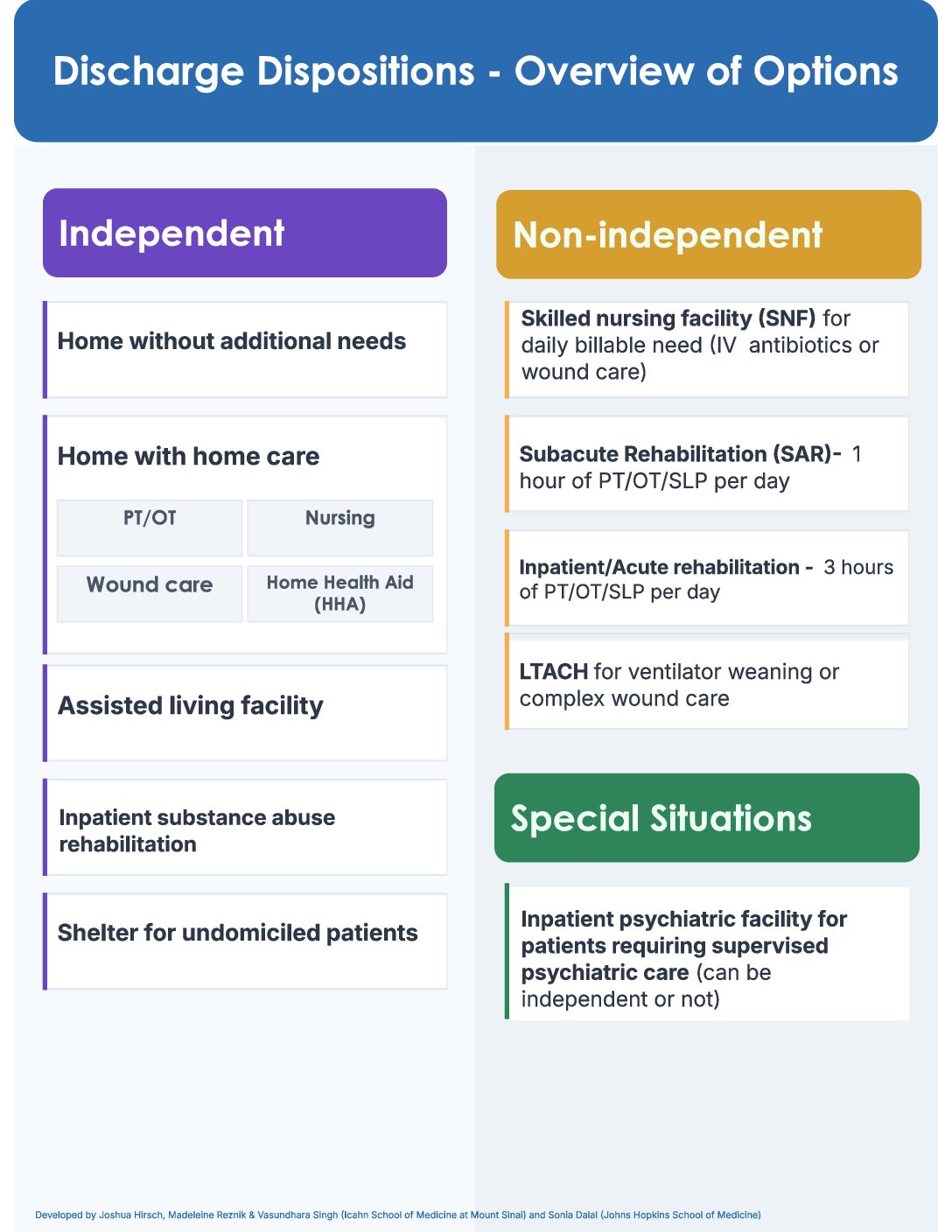
Discharge Dispositions: Overview of Options
| Independent | Non-independent |
| Home without additional needs | Skilled Nursing Facility (SNF) for daily billable need (IV antibiotics or wound care) |
| Home with home care: PT/OT; Nursing; Wound care; Home Health Aide (HHA) | Subacute Rehabilitation (SAR) – about 1 hour of PT/OT/SLP per day |
| Assisted living facility | Inpatient/Acute Rehabilitation – about 3 hours of PT/OT/SLP per day |
| Inpatient substance abuse rehabilitation | LTACH: ventilator weaning or complex wound care |
| Shelter for undomiciled patients |
| Special situation |
| inpatient psychiatric facility for patients requiring supervised psychiatric care (may be independent or not) |
Discharge Dispositions – SAR Process
- Assess PT/OT needs and place orders
- Receive PT/OT recommendations
- Ensure patient is amenable to SAR
- Case management/social work makes referrals
- Patient is accepted by a facility
- Authorization is approved
- Facility has an available bed
- Discharge to facility
Discharge Dispositions – Deep Dive
Not Independent
Acute Inpatient Rehabilitation (ACIR)
- Recommended by PT, OT, and SLP (requires two disciplines to recommend this level of care—most of the time at least PT is required)
- Patient must be able to tolerate 3 hours of therapy per day.
- Internal ACIR requires a PM&R consult and outside ACIR’s case management/social work will connect with liaisons.
- ACIRs are sometimes units within a hospital, but not always and can be freestanding rehabs.
- Length of stay is about 7-10 days (exceptions: stroke or spinal cord injuries about 3-4 weeks).
- Typically paid for by insurance; though some patients may have a copay; need preauthorization/clearance before transfer — handled by admissions office of ACIR.
Sub-Acute Rehabilitation (SAR)*
- Recommended by PT, OT, or SLP.
- Patient can tolerate up to 60 minutes of therapy per day, 5 days per week.
- Located at independent nursing/rehabilitation facilities.
- Length of stay about 21-30 days (insurance will typically stop paying after 21 days, and the patient can continue to pay privately, discharge home, or transition to long-term care.
- Typically paid for by insurance, though some patients may have a copay; needs insurance authorization prior to final acceptance.
- Medicare patients get 100 days/year — first 20 days completely covered, then 80 days with a copay or covered bysecondary insurance.
- Staffing:
- Daytime nursing staff (LCN, not RN): 1 nurse to 20 patients
- Nighttime nursing staffing (LCN, not RN): 1 nurse to 40 patients
- Physician required to see patient within 48 hours and then every 30 days.
- PCP appointment is not covered, but subspecialties are covered and transportation is arranged by the facility.
Skilled Nursing Facility (SNF)
- Requires a billable skilled need (at least once daily) such as wound care or IV antibiotics.
- Located at independent nursing/rehabilitation facilities.
- Length of stay depends on the need (i.e., patient needs 6 weeks of IV antibiotics, they will stay for the entirety of the course)
- Typically paid for by insurance; though some patients may have a copay.
- Usually covered by Medicaid.
Long-Term Acute Care Hospital (LTACH)
- Specialized inpatient facility for complex medical conditions aka lateral transfer.
- Includes ventilator weaning, complex wound care, and long-term IV antibiotics.
- Bridges between the acute care hospital and lower levels of care, such as inpatient rehabilitation or skilled nursing facilities, for patients who are too medically fragile for discharge but no longer require the full services of an acute care hospital.
- Provider is in-house 24/7.
*2-Midnight Rule: The patient must have an acute hospital stay meeting the two-midnight rule to qualify for Medicare coverage of SAR or SNF care.
Long-Term Care Facility (LTC)
- Requires a 3871B form, which medical team needs to review and sign. The form is then submitted to determine necessity for this level of care. Can take up to 7 days to receive a response.
- Typically, the patient initiates care as a SNF or SAR patient and then will transition to an LTC after 21 days or insurance stops paying.
- Requires family to provide extensive financial materials.
- Length of stay depends on the need, can be a lifetime.
Note: SAR, SNF, and LTC may be located at the same facility and the names are often used interchangeably, although patient qualifications differ. Typical barrier: sitters/restraints generally must be removed for 24 hours before discharge to a facility.
Independent
Assisted Living Facility (ALF)
- Private pay.
- Sometimes at a facility-type setting, though often in a house with few residents.
- Requires forms to be completed by medical team
- Patients with low income will often need to contribute their full income to the ALF.
- Typically provided with all of their care needs (meals, transportation, medication management, and money management).
Home Care
- Requires a patient has stable housing.
- Various home care orders available: durable medical equipment (DME), PT, OT, SLP, social work, oxygen, skilled nursing (i.e., wound care, IV antibiotics, tracheostomy, Foley, PEG).
- Consult with your home care coordinator who can assist in determining whether patient meets admission criteria, insurance coverage, and availability of service provider.
- Requires medical team to place home care orders; insurance typically pays, but patient may have copay.
Inpatient Substance Abuse Rehabilitation
- Structured 24/7 residential program providing medical care, therapy, and support to help individuals safely detox and begin long-term recovery from substance use disorders.
Shelter
- For undomiciled patients.
- May require the provider to complete a shelter packet.
Special Situations
Inpatient Psychiatric Treatment
- Licensed hospital or district unit within a hospital that provides 24-hour, supervised psychiatric care to patients with acute mental health conditions who require a level of care that cannot be safely managed when in outpatient or less restrictive setting.
- Can be voluntary or involuntary; patients can be independent or not independent.
- 190-day lifetime limit for Medicare patients in free-standing facilities (does not apply to in-hospital units).
- Many states have limits on Medicaid funding for free-standing facilities, so often these patients must go to hospital-based psychiatric unit.
Developed by Joshua Hirsch, Madeleine Reznik & Vasundhara Singh (Icahn School of Medicine at Mount Sinai) and Sonia Dalal (Johns Hopkins School of Medicine)