Patient-Centered Care
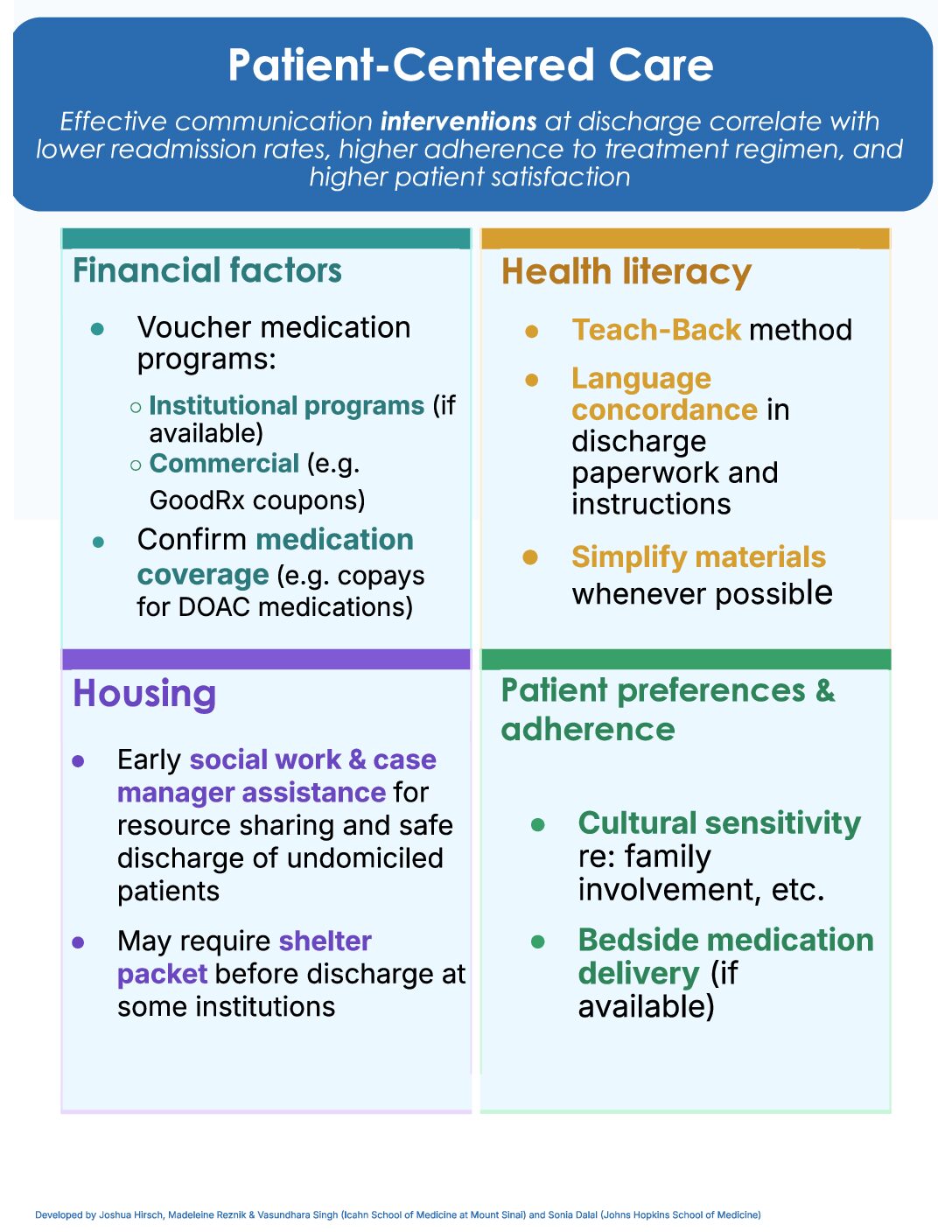
Effective communication interventions at discharge correlate with lower readmission rates, higher adherence to treatment regimen, and higher patient satisfaction.
-
Financial factors · Voucher medication programs: institutional programs (if available); commercial programs (e.g., GoodRx coupons).
· Confirm medication coverage (e.g., copays for DOAC medications).
Health literacy · Use the Teach-Back method.
· Use language-concordant discharge paperwork and instructions.
· Simplify materials whenever possible.
Housing · Arrange early social work and case manager assistance for resource sharing and safe discharge of undomiciled patients.
· A shelter packet may be required before discharge at some institutions.
Patient preferences and adherence · Use cultural sensitivity regarding family involvement and related preferences.
· Arrange bedside medication delivery, if available.
Patient-Centered Care – Preventing Readmissions
Effective communication interventions at discharge correlate with lower readmission rates, higher adherence to treatment regimen, and higher patient satisfaction.
| Communication and Patient Education
· Specific points to reiterate to the patient: new medications (name, dose, timing, and purpose); inhaler technique. · Reinforce aspects of the care plan that prevent readmissions or negative outcomes: important follow-up appointments, expected symptoms, and return precautions. · Provide written handouts and instructions in the patient’s preferred language and at an appropriate literacy level (e.g., UpToDate patient education material). |
Readmission Reduction Strategies
· Tailor readmission-reduction strategies to the patient’s needs. · Schedule follow-up appointments before discharge. · Use a Transition of Care Team, when available, to contact patients after discharge and reduce readmission risk. |
Reference:
- Fraze TK, Brewster AL, Lewis VA, Beidler LB, Murray GF, Colla CH. Prevalence of Screening for Food Insecurity, Housing Instability, Utility Needs, Transportation Needs, and Interpersonal Violence by US Physician Practices and Hospitals. JAMA Network Open. 2019;2(9):e1911514. doi:10.1001/jamanetworkopen.2019.11514. PMID: 31532515; PMCID: PMC6752088.
Developed by Joshua Hirsch, Madeleine Reznik & Vasundhara Singh (Icahn School of Medicine at Mount Sinai) and Sonia Dalal (Johns Hopkins School of Medicine)